The devastating impact of forest fires extends far beyond charred landscapes and destroyed property, often leaving behind stories of profound animal suffering and emotional depth. A poignant video recently captured a moment so raw and tragic that it has resonated with millions across the globe. In the aftermath of a chaotic wildfire, a scene unfolded that blurs the line between human and animal emotion, proving that the bond between a parent and a child transcends species. Amidst the smoking ruins of a forest, a police officer stumbled upon a sight that was both terrifying and deeply sorrowful, capturing the devastating reality that wild animals face during environmental disasters.
This powerful footage serves as a stark reminder of the hidden casualties of natural disasters, shining a light on the emotional lives of creatures we often view from a distance. The video does not just document the physical destruction of a wildfire; it documents a profound psychological trauma. For viewers, it offers a rare, unfiltered look into wildlife behavior under extreme distress, challenging our understanding of how animals process loss. As the camera pans across the bleak, ash-covered landscape, the focus shifts from the massive scale of the fire to an intimate, localized tragedy that encapsulates the entire disaster in one heartbreaking image.
A Symbol of Unyielding Devotion Amidst the Ashes
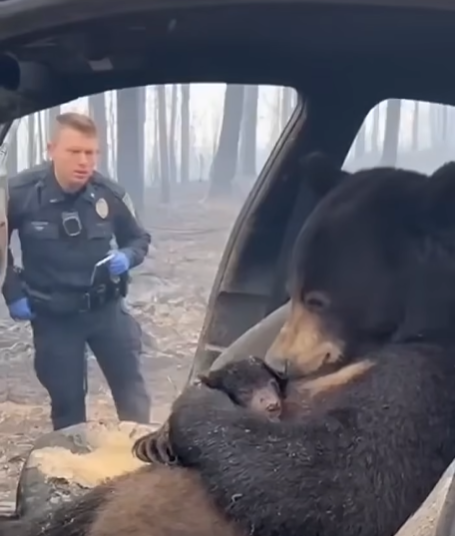
At the center of this viral video is a mother black bear seeking refuge inside the burnt-out shell of an abandoned car, holding what remains of her world. Despite the imminent danger and the suffocating environment, she wouldn’t let go of her lifeless cub, who had tragically succumbed to smoke inhalation. The mother bear sat silently in the passenger seat, cradling her baby against her chest in a universal gesture of maternal protection and intense grieving. This image of a wild predator rendered completely immobile by grief has struck a chord worldwide, turning the bear into a powerful symbol of motherly love and unyielding devotion.
The visual juxtaposition of the powerful, dark fur of the bear against the rusted, ash-coated interior of the car creates a haunting tableau. She remained completely unmoving, seemingly indifferent to her own safety or the presence of human rescuers who approached with caution. Her behavior contradicts the typical survival instinct of wild animals, which dictates fleeing from danger and abandoning the dead to save oneself. Instead, this mother chose to stay, guarding her baby against a world that had already taken its life, demonstrating a depth of feeling that commands absolute respect and empathy from everyone who witnesses the footage.
The Delicate Rescue Operation and Gaining Trust
The interaction between the first responders and the grieving animal highlights the complex nature of wildlife rescue operations in disaster zones. A police officer, visible in the video, approached the vehicle with a mix of caution and visible empathy, recognizing the volatile nature of a grieving, powerful predator. Rescuers reportedly spent hours patiently working to gain her trust, understanding that any aggressive or rushed movement could trigger a defensive attack. This delicate process required immense patience, as the team used soft vocalizations and non-threatening body language to communicate their peaceful intentions to the traumatized mother.
As the rescue team slowly managed to bridge the gap between human and animal, the emotional weight of the situation only intensified. The moment they finally managed to gently remove the deceased cub from her arms was fraught with tension and sorrow. True to her protective instincts, the mother bear did not flee into the surrounding woods once her arms were empty; instead, she followed the rescuers closely as they carried her baby away. She walked step for step behind them, ensuring that her beloved cub never left her sight, proving that her commitment to her offspring did not end when the cub’s heart stopped beating.
Analyzing the Depths of Animal Sentimentality and Grief
This extraordinary footage provides valuable insights for wildlife biologists and animal behaviorists studying sentimentality and grief in the animal kingdom. While science has historically been cautious about attributing human emotions to animals, instances like this make it increasingly difficult to deny the existence of a complex emotional life in mammals. The mother bear’s refusal to abandon her dead cub mirrors behaviors observed in elephants, cetaceans, and primates, who are known to undergo periods of mourning. This video serves as visual evidence that the neurological and emotional pathways governing maternal bonds are deeply ingrained and incredibly powerful.
Furthermore, the video forces a reassessment of how we manage wildlife areas and plan for disaster responses. As climate change increases the frequency and intensity of wildfires, encounters between displaced, traumatized wildlife and human emergency services will inevitably rise. Understanding that animals experience shock, fear, and profound grief during these events is crucial for developing humane and effective rescue protocols. The patience demonstrated by the officer in the video sets a standard for future wildlife interactions, showing that empathy and respect are just as important as specialized equipment when dealing with animals in crisis.
An Enduring Message of Love and Resilience
Ultimately, this tragic encounter in the burnt forest leaves behind a message that extends far beyond the immediate horror of the wildfire. In a world often characterized by fleeting connections, the image of this mother bear stands as a testament to the fact that true love never runs and never gives up. She faced the ultimate tragedy with a quiet, dignified resilience that has deeply moved the digital world, transforming a localized wildlife rescue into a universal story of devotion. Her story elevates the conversation around animal welfare, reminding us of our responsibility to protect the natural world and the sentient beings who inhabit it.
As the video continues to be shared across social media platforms, it serves as an educational tool and an emotional touchpoint for conservation efforts. It reminds us that every acre of forest lost to a fire represents a home destroyed and families torn apart, regardless of the species. The legacy of this mother bear and her cub will hopefully inspire greater efforts toward wildfire prevention and more robust support for wildlife rehabilitation centers. In the end, the image of her cradling her baby in that ruined car remains etched in the collective memory, a heartbreaking yet beautiful reminder that love is the most powerful force on Earth.