The entire office went silent as Mr. Harris walked toward the old wooden desk that had belonged to my father. Victoria immediately stepped in front of him. “What drawer?” she demanded. Mr. Harris looked at her calmly. “The one your husband was told never to open until the right time.” My heart began pounding. The desk had been in my father’s private office for decades. I had seen him use it countless times, but I had never once seen him open the bottom drawer. Mr. Harris reached into his pocket and pulled out a small brass key. Victoria’s face suddenly changed. “Where did you get that?” she asked. He looked at me. “Your father gave it to me two weeks before he passed away.”
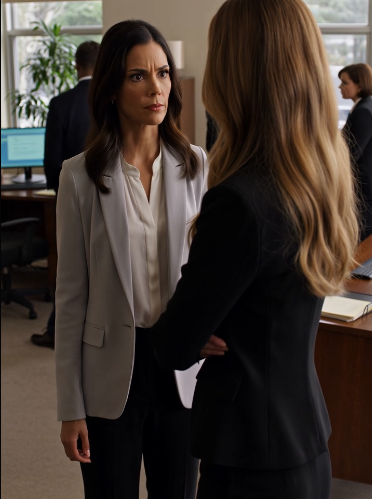
He unlocked the drawer and removed a thick folder. My brother had been standing near the hallway, listening to everything. The moment he saw the folder, his face went pale. Victoria turned toward him. “You know what that is?” He didn’t answer. Mr. Harris opened the folder and revealed years of financial records, contracts, and handwritten notes from my father. “Your father instructed me to keep these documents safe,” he said. “He told me that if anyone ever tried to claim this woman was a charity case, the truth needed to be shown.” Victoria stared at me. I didn’t understand what he meant. Mr. Harris then handed me the first document.
It was a series of financial reports showing that for nearly fifteen years, I had quietly provided interest-free loans to the company during its most difficult periods. When the business nearly collapsed during a major economic downturn, I had used my personal savings to cover payroll. When a major client failed to pay an invoice, I had personally helped the company meet its obligations. I had never told anyone—not even my brother—because my father had asked me to keep the assistance private. I had believed I was helping my family. My father, however, had kept detailed records of every contribution. Victoria looked at my brother. “You never told me.” He lowered his head. “I didn’t know everything.”
Mr. Harris then opened another document. It was my father’s final succession plan. While my brother had inherited the company’s ownership, my father had appointed me as the independent financial trustee with authority to review major company decisions and protect the business from reckless management. My brother had known about the arrangement but had never explained it to his wife. The reason became obvious when Mr. Harris revealed that my father had included a clause stating that if my brother ever allowed someone to misuse the company or publicly damage its employees, the trustees could remove him from executive control. Victoria had just created a serious problem by publicly humiliating me and making false statements about my role.
My brother finally walked toward me. “I should have told you.” I looked at him. “You should have told her the truth.” He nodded. “I was embarrassed.” He admitted that he had always felt like he lived in my father’s shadow. I had been the one who quietly helped the company financially, while he had been the one everyone saw in the office. When their father died, my brother became desperate to prove that the company belonged to him. He allowed Victoria to believe I was insignificant because admitting the truth would have forced him to face how much help he had received.
Victoria stood silently as the employees began to understand what had happened. The oldest employee in the company looked at her and said, “Your father-in-law never called her a charity case. He called her the reason the company survived long enough for your husband to inherit it.” Victoria’s face turned red. She apologized, but I told her that an apology couldn’t erase years of disrespect. My brother later removed her from all company management decisions and publicly corrected every false statement she had made about me.
I didn’t take control of the company.
I didn’t want it.
I simply remained as the independent trustee my father had chosen me to be.
A few months later, my brother and I finally had the conversation we should have had years earlier. He admitted that he had spent his entire life trying to prove he was worthy of our father’s approval. I told him that Dad had never wanted us to compete. He had simply wanted both of us to succeed in different ways.
Before I left his office that day, I placed my father’s old brass key on the desk.
My brother looked at it.
“Don’t you want to keep it?”
I smiled.
“No.”
Then I added,
“Dad didn’t leave me a locked drawer. He left me the truth. That’s worth more than anything inside it.”