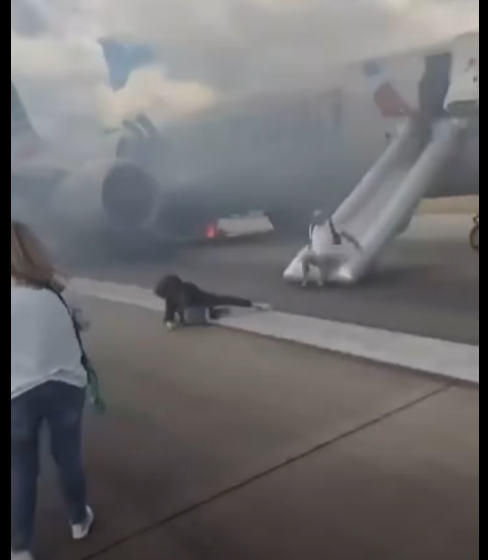
The global aviation community and the public are currently locked in a state of heightened anxiety as news of a severe aviation incident involving a commercial passenger airliner continues to dominate international headlines. Initial reports coming from air traffic control and airport ground operations indicate that a high-capacity aircraft, carrying more than 240 souls—including a full manifest of passengers and a dedicated flight crew—was involved in a critical accident. The emergency manifested either shortly after the high-stress takeoff phase or during an equally volatile segment of the flight profile, sending shockwaves through regional tracking networks. While confirmed details from the scene remain frustratingly limited, the sheer scale of the potential tragedy has generated massive concern, prompting an immediate, multi-agency mobilization of emergency medical services and federal aviation authorities.
In the immediate aftermath of a commercial aviation crisis, the first few hours are defined by a desperate race against time to secure the site and preserve vital evidence. First responders, including airport fire departments, local search and rescue teams, and disaster management personnel, were dispatched to the suspected coordinates within minutes of the aircraft dropping off secondary radar screens. As images of emergency vehicles with flashing lights lined up near the tarmac begin to circulate globally, the psychological toll on the families of those on board grows heavier. Aviation networks have shifted into crisis communication mode, attempting to balance the public’s urgent demand for transparency with the logistical reality of managing a highly sensitive, evolving disaster zone.
The Complex Anatomy of an Aviation Investigation: Unraveling the Invisible Clues
Scrutinizing Technical Data and the Role of the Flight Recorder
As the initial rescue and containment efforts stabilize, the monumental task of determining the root cause of the accident falls squarely upon the shoulders of elite accident investigation boards. Investigators are rapidly descending upon the debris field, with their primary, immediate objective being the recovery of the aircraft’s highly resilient “black boxes”—the Flight Data Recorder (FDR) and the Cockpit Voice Recorder (CVR). These sophisticated devices hold the definitive key to understanding the final moments of the flight, capturing thousands of parameters including airspeed, altitude, engine thrust settings, control surface movements, and the final verbal communications between the captain and the first officer. Until these data streams are safely extracted and meticulously analyzed in specialized laboratory environments, any definitive statement regarding mechanical failure remains purely speculative.
Evaluating Volatile Weather Patterns and Maintenance Histories
Beyond the digital footprint left by the aircraft’s internal computers, investigators must carefully reconstruct the complex environmental matrix that surrounded the plane during its critical phase of flight. Teams of meteorologists and forensic engineers are thoroughly analyzing local microclimate data, searching for evidence of sudden wind shear, severe turbulence, bird strikes, or catastrophic atmospheric anomalies that could have overwhelmed the aircraft’s aerodynamic limits. Concurrently, a parallel investigation is being launched into the airline’s maintenance warehouses, where teams are auditing the specific aircraft’s lifelong service records, looking for any history of recurring structural anomalies, recent engine overhauls, or deferred maintenance items that might have compromised the structural integrity of the fuselage.