The entire room fell silent as my mother placed the envelope on the table. My sister stared at her. “Mom, what is that?” My mother looked at her for a long moment before answering, “The truth you should have told them yourself.” My sister’s face changed. She had clearly expected my mother to support her accusation. Instead, Mom opened the envelope and pulled out a stack of documents. “For the last three years,” she said, “your sister has been paying my mortgage, medical expenses, utilities, and home repairs.” Everyone looked at me. I immediately shook my head. “Mom, please don’t.” But she continued. “She has never once told anyone because she didn’t want you to feel ashamed.” My sister stared at me in disbelief. “You paid for all that?” I lowered my eyes. “You said you were struggling.” My sister suddenly laughed bitterly. “And you never told me?”
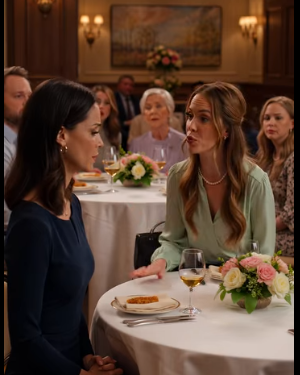
I looked at her. “You were struggling too. You had children. You were trying to keep your own family together.” My sister’s expression began to crumble. For years, she had convinced herself that I had abandoned our mother because I lived several hours away. What she didn’t know was that I had quietly taken responsibility for the expenses while she visited Mom in person. I had never considered it a competition. She was there physically. I was helping financially. We had both been caring for our mother in different ways. But my sister had never known about my part because Mom had promised to keep it private.
Then Mom revealed the reason she had brought the envelope. Inside was a letter from my sister, written several years earlier. She had once written to Mom saying she felt guilty because she couldn’t afford to help more. She had asked Mom not to tell anyone. My mother had kept that letter, and when I discovered it, I began sending money quietly. I never wanted my sister to feel like she had failed. I never wanted our mother to become something we fought over. My sister began crying. “You let me believe you didn’t care.” I answered softly, “I never knew you believed that.”
She looked at me and admitted that her resentment had grown because she saw me arrive only for special occasions while she handled appointments, groceries, and emergencies. She hadn’t realized that every time she called Mom saying she needed money for medicine or repairs, Mom used the money I had sent. The truth was painful for everyone because neither of us had intended to hurt the other. We had simply been caring for the same woman from opposite sides of the distance.
My mother took both of our hands. “I didn’t raise two daughters so you could spend your lives trying to prove who loved me more.” My sister began sobbing and apologized to me in front of everyone. I hugged her immediately. We cried together, not because everything had suddenly become perfect, but because we finally understood how much unnecessary pain had come from silence.
The birthday dinner continued after that. My mother opened my gift and stared at the restored photograph for a long time. In the picture, my sister and I were little girls standing on either side of her, both holding her hands. Mom smiled and said, “This is what I want to remember. Not who paid more. Not who visited more. Just my two daughters beside me.”
Later that night, my sister and I sat together in the parking lot and made a promise. From then on, we would stop keeping score. We would talk openly about our mother’s needs, share responsibilities honestly, and never again mistake distance for indifference.
Before we left, Mom placed the old photograph on the table and said:
“Love doesn’t always look like showing up at the door. Sometimes it looks like the person who keeps the lights on, the medicine paid for, and the family together without asking anyone to notice.”
That night, my sister finally understood that I had never abandoned our mother.
I had simply been loving her from farther away.