Nature has a profound way of surprising us with its hidden secrets, often forcing us to confront the boundaries of our own biological knowledge. In the fascinating video titled “He brought home an unusual creature from the woods. One year later, the transformation shocked him,” the audience is immediately introduced to a bizarre, almost otherworldly animal that challenges standard identification. Found deep within a dense forest, this tiny, fragile organism seems like a cross between a mythical beast and a newly discovered species. The initial footage captures the sheer shock of the rescuer as he cradles the jet-black, leather-skinned creature in the palm of his hand, realizing that this was no ordinary woodland inhabitant. By examining this footage, we can dive deep into the initial characteristics of this enigmatic baby exotic animal and explore how its physical traits hint at a much larger evolutionary story.
A Visual Analysis of the Bizarre Newborn Mammal
The Striking Facial Features and Oversized Eyes
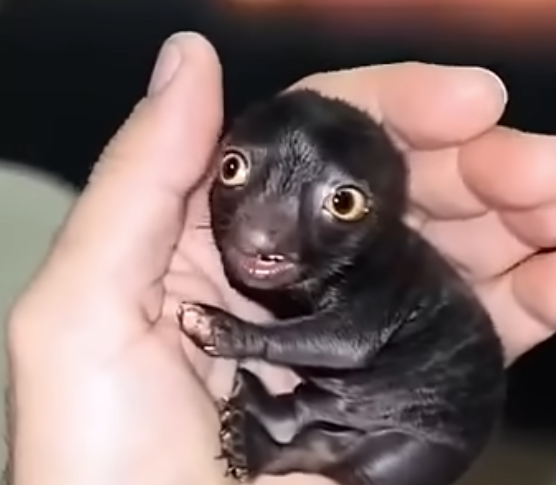
The most captivating aspect of the creature in the video is undoubtedly its facial structure, which immediately draws the viewer’s eye due to its intense and unusual proportions. It possesses exceptionally large, round, golden-amber eyes that seem entirely too big for its tiny skull, giving it a permanently startled or hyper-aware expression. These prominent ocular traits strongly suggest an evolutionary adaptation to nocturnal life or low-light environments, such as dense jungle canopies or subterranean burrows where maximizing light absorption is critical for survival. Its mouth is slightly agape throughout the clip, revealing tiny, developing teeth and a prominent lower jaw structure that distinguishes it from common domestic pets or standard forest wildlife found in temperate zones.
Physical Morphology and the Delicate Intricacies of its Limbs
As the camera pans closer, we can analyze the creature’s body, which is mostly hairless, featuring a glossy, dark, wrinkled skin texture that resembles a newborn pup of a highly specialized mammal. Its torso is curled tightly into a defensive, fetal posture within the human hand, illustrating its vulnerability and its reliance on external warmth for thermal regulation. Most notably, the tiny feet are equipped with distinct, elongated claws or specialized digits that appear built for gripping, climbing, or digging through complex terrain. The absence of thick fur coupled with the complex structure of its paws points toward a species that undergoes a dramatic animal transformation as it matures from a delicate infant into a fully capable adult predator or forager.
Speculating the Species: Is It an Aye-Aye, Lemur, or Something Unique?
Evaluating the Primate and Marsupial Hypotheses
Whenever an unusual creature is discovered in the wild, wildlife enthusiasts and biologists immediately begin the process of elimination to determine its true taxonomy. The large eyes, gripping hands, and dark coloration heavily mirror the infant stages of certain rare primates, specifically the aye-eye or various nocturnal lemur species native to isolated ecosystems. These animals are famous for their unique, elongated fingers and striking eyes, which often terrify or fascinate locals in their native habitats. Alternatively, some viewers might hypothesize that the creature is a rare marsupial or a specialized bat species that fell from its roost before its wings and fur could fully develop, leaving it looking like a bald, alien-like entity.
The Phenomenon of Extreme Animal Transformations in Nature
The core narrative of the video hinges on the jaw-dropping evolution that this animal undergoes over the course of twelve months, a theme that resonates deeply with lovers of natural history. In the animal kingdom, phenotypic plasticity and maturation can alter an organism’s appearance so drastically that the adult looks entirely unrelated to its infant self. Think of how a scrawny, hairless bird matures into a majestic raptor, or how certain mammals shed their neonatal skin layers to reveal vibrant coats and imposing skeletal frames. This incredible forest animal rescue highlights the unpredictable journey of raising a wild creature, where a year of proper nutrition, temperature control, and care completely shifts its biological trajectory from a helpless, unidentifiable blob into a magnificent, recognizable force of nature.
The Ethical Implications and Responsibilities of Rescuing Wild Creatures
The Danger of Removing Unknown Wildlife from Natural Habitats
While the story of bringing home an unusual creature from the woods is undeniable romantic and thrilling, it raises critical discussions regarding wildlife conservation and ethical responsibility. When hikers or foragers encounter a seemingly abandoned baby animal, their first instinct is often to intervene, assuming the mother has perished or abandoned her offspring. However, in many cases, wildlife mothers temporarily leave their young hidden in safe spots while they forage for food nearby, meaning human intervention can inadvertently separate a healthy baby from its parent. Taking an unknown, potentially endangered species out of its natural habitat requires immediate consultation with professional wildlife rehabilitators rather than attempting to domesticate it at home.
The Crucial Role of Professional Wildlife Rehabilitation Centers
For an exotic or highly unusual creature like the one seen in the video to thrive and complete its shocking transformation safely, it requires highly specific dietary formulations and environmental conditions that a standard household cannot provide. True wildlife rehabilitation involves analyzing the animal’s scat, monitoring its bone density development, and preparing it for eventual reintroduction into the wild so it does not become entirely dependent on humans. The awe-inspiring journey from a tiny, wide-eyed, hairless anomaly into a stunning adult animal serves as a beautiful testament to the resilience of life, reminding us of our duty to protect and respect the mysterious fauna that shares our planet.