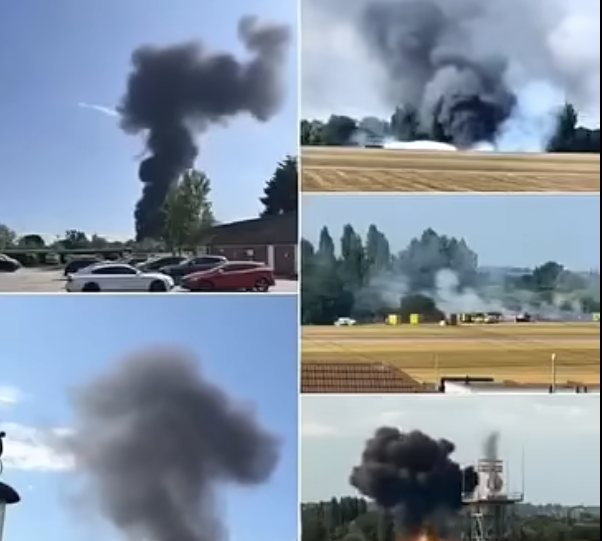
A shocking airfield explosion video has recently caught the attention of netizens worldwide, capturing a sudden and severe industrial accident that unfolded under clear blue skies. The dramatic footage reveals a peaceful afternoon instantly shattered by a massive eruption of dark, billowing smoke that can be seen from miles away. In the initial seconds of the video, a towering column of thick black smoke dominates the horizon, rising dramatically above a parking lot filled with various modern vehicles and a low-rise residential building. The sheer scale of the smoke plume indicates that a significant combustion event or high-energy blast has just occurred within the vicinity. Nearby trees and green foliage stand in stark contrast to the dark, hazardous materials being released rapidly into the clean upper atmosphere. Onlookers and residents from surrounding neighborhoods are left stunned as they witness the dark cloud expand outwards and mask the bright daylight. The disturbing visual elements captured in this initial sequence emphasize the extreme unpredictability of modern mechanical or fuel-related failures. This viral clip serves as a powerful reminder of how fast a routine day at a specialized transport facility can devolve into an active emergency zone.
Deep Analysis of the Massive Smoke Plume and Immediate Impact
The physical characteristics of the catastrophic airfield blast are documented through several distinct camera angles, providing a comprehensive view of the ongoing disaster. As the camera cuts to a closer perspective of the open field, the true origin of the intense fire becomes increasingly apparent to viewers. A violent mixture of thick white steam and dark carbonaceous smoke erupts continuously from a specific point on the dry, grassy ground. The massive volume of smoke indicates the involvement of highly volatile compounds, likely aviation fuel or specialized industrial machinery. The smoke column does not merely dissipate but instead forms a dense, churning vortex that rises steadily into the atmosphere. The turbulent motion within the cloud suggests that an active, high-temperature fire is still feeding the disaster from below. The surrounding landscape, consisting of wide-open golden fields, appears exceptionally dry, which introduces a major risk of a secondary brush fire breaking out. This haunting footage clearly captures the terrifying speed at which an initial point-source explosion can consume the surrounding air and alter local visibility.
Emergency Response and Hazardous Area Management
Further segments of the video reveal a coordinated but high-stakes response to the airfield accident smoke as emergency vehicles begin arriving at the perimeter. A bright yellow fire truck and several support vehicles are seen stationed along the edge of the paved runway, their flashing emergency lights reflecting against the dry grass. The rescue personnel appear to be establishing a strict safety perimeter around the active blast zone to protect secondary structures and personnel. The distance maintained by the emergency crews suggests that the threat of secondary explosions or toxic gas inhalation remains exceptionally high. The open airfield environment complicates firefighting efforts, as shifting winds can easily redirect the massive smoke cloud toward nearby residential areas or active roads. Thick layers of low-lying smoke can be observed drifting lazily across the horizon, creating a hazy barrier that completely obscures the background trees and structures. The presence of specialized utility trucks indicates that technicians are likely working to isolate fuel lines or electrical grids that could further fuel the inferno. This segment highlights the critical importance of rapid-response protocols and advanced preparation when dealing with high-risk transport facilities.
Close-up Views of the Fireball and Structural Threats
The gravity of this industrial explosion footage is further emphasized by a dramatic close-up sequence showing the actual flame front. For a brief moment, a brilliant orange fireball erupts violently from the base of the main smoke column, indicating a sudden re-ignition or a breach of a pressurized container. The intense thermal energy released by this flash creates a rapid expansion of the dark cloud, pushing it even higher into the sky. In the foreground of this specific angle, a steel lattice tower equipped with monitoring equipment or communication antennas stands remarkably close to the danger zone. The dark smoke curls around the metallic framework of the tower, illustrating the immediate threat posed to vital airfield infrastructure. This close proximity raises serious concerns regarding the long-term structural integrity of the surrounding facility and its specialized equipment. The contrast between the bright, destructive flames and the cold, gray industrial equipment creates a visually striking but deeply unsettling image. It is evident that the force of the blast has already caused extensive damage to whatever machinery or vehicle was located at the center of the incident.
Long-term Safety Implications and Digital Media Trends
The viral nature of this aviation facility disaster video has sparked widespread discussions across social media platforms regarding workplace safety and infrastructure resilience. Experts analyzing the clip note that events of this magnitude require rigorous post-incident forensic investigations to determine the exact mechanical or human error involved. By examining the dispersion patterns of the smoke and the color of the flames, engineers can glean valuable information regarding the fuel type and combustion efficiency. Videos documenting such raw, unedited industrial accidents often serve as crucial training material for emergency management teams and safety inspectors worldwide. The high level of public engagement with this video underscores a global fascination with dramatic, real-life events that disrupt our highly controlled environments. As technology allows for more immediate documentation of such crises, the public gains a deeper appreciation for the dangerous work performed by first responders. The footage remains a haunting, modern document of structural vulnerability, emphasizing that safety regulations must continuously evolve to mitigate such devastating risks. Ultimately, this intense video leaves a powerful impression, reminding us that constant vigilance is the absolute foundation of industrial operational safety.